Every room at its own temperature
Bedrooms cooler than the living space, bathrooms warm at the right hour, and the cold north-facing room heated for as long as it actually needs.

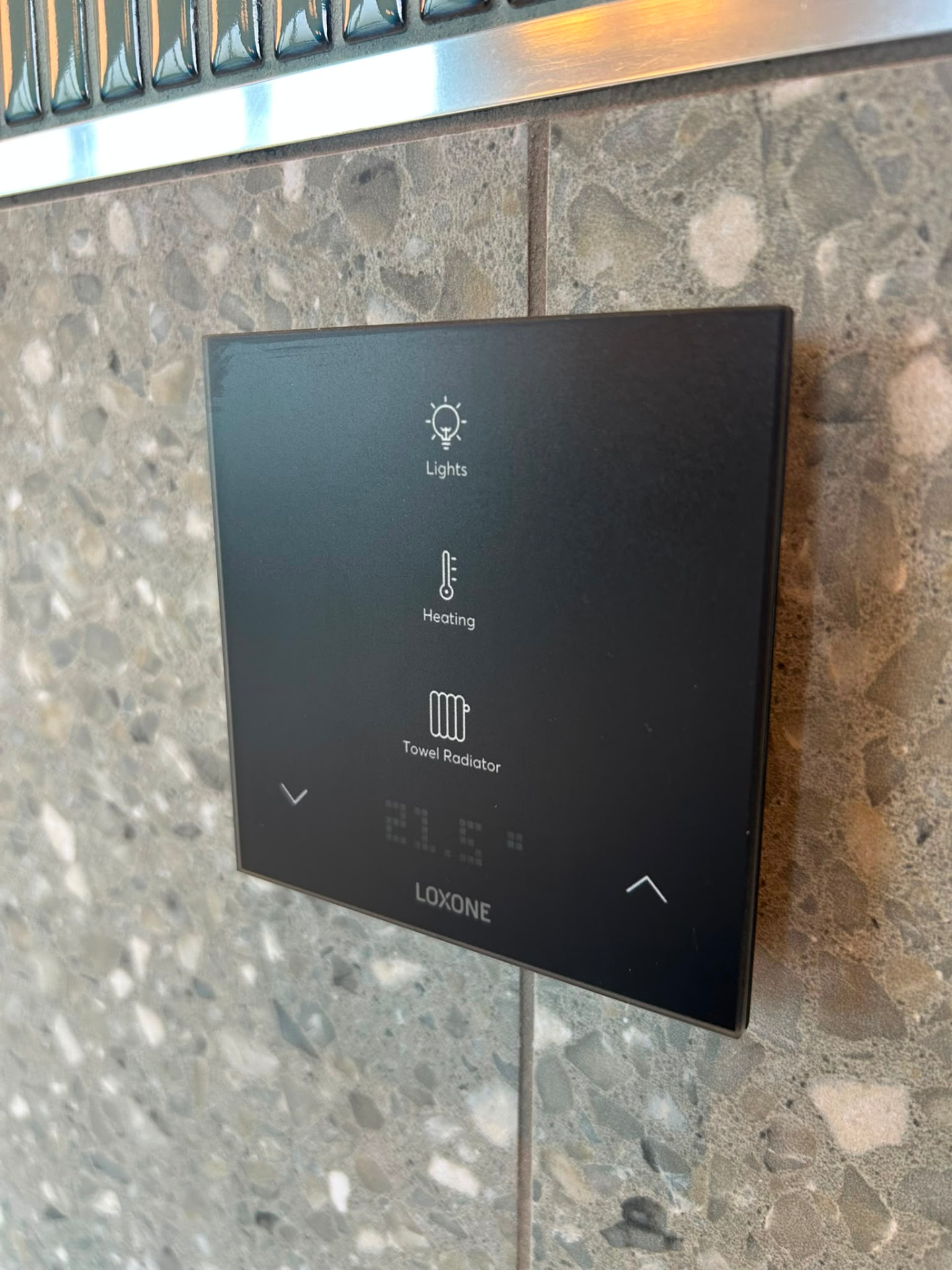
Derby · Heating, HVAC and shading control
Stop heating empty rooms just to keep one cold one comfortable. Individual room control, underfloor zoning, HVAC and automated shading all on one system that reacts to occupancy, the weather, and where you actually are in the house.
16+ years of control and commissioning experience · Free initial consultation · 6-year NAPIT-backed workmanship guarantee on qualifying installations
16+ years
Domestic, commercial and industrial experience
Full Scope
NAPIT registered for all aspects of electrical work
6-year
NAPIT-backed workmanship guarantee on qualifying installs
£10m
Public and employers' liability cover
Free
Initial consultation, no obligation
The service
Climate control gives every room its own target temperature and schedule, then leaves a controller to decide which zones need heat, cooling or shading, and when to start so the room is right when you asked for it. That covers wet underfloor heating manifolds, radiator actuators, air conditioning and heat pump control, mechanical ventilation and motorised blinds.
Most houses run on a single thermostat stuck in a corridor nobody occupies. Bedrooms overheat, the north-facing room stays cold, and the boiler runs flat out to satisfy a sensor in the worst possible spot. Zoning fixes the comfort problem and cuts running hours at the same time, since empty rooms stop being heated to the same setpoint as full ones.
We handle the control side of things, sensors, actuators, wiring centres, zone valves, thermostats, blind motors and the programming, and coordinate with your heating engineer on the mechanical side. As a Full Scope NAPIT contractor we design the electrical work and the control strategy together from the start.
What it costs to leave it
There's no single bill you can point at for poor heating control. It's a small daily overpayment. Bedrooms heated all evening while everyone's downstairs. A boiler cycling to satisfy a hallway sensor next to a draughty front door. Rooms overshooting because the system has no idea how long that particular room takes to warm up.
Comfort suffers as well. People open windows in the rooms that are too hot, run plug-in heaters in the one that's cold, or just nudge the thermostat up two degrees for the whole house to fix one room. That raises consumption across every radiator to solve a problem in a single one.
Heat pumps make control quality matter even more. They deliver heat at lower flow temperatures over longer periods, so a system that hammers on and off, or fights against closed zone valves, runs inefficiently and costs more to run. Overheating works the same way in reverse. Unshaded south-facing glazing loads heat in all afternoon, then air conditioning has to remove it all evening.
How the job runs
01
We look at the property, the heat source, any existing zoning and where the hot and cold spots actually are, then tell you what would make a measurable difference.
02
Zone plan, sensor and actuator schedule, wiring centre layout, interface with the heat source, and a control strategy that includes setbacks per room.
03
Sensors, actuators, wiring centres, valve and manifold wiring, blind motors and HVAC interfaces go in, coordinated with the heating engineer on site.
04
Every zone is proved to open and close the right valve, schedules loaded, weather compensation and shading rules configured, all watched under real load.
05
Electrical certification, a walkthrough of the schedules and overrides, and optional remote maintenance for the seasonal adjustments.
What you actually get
Bedrooms cooler than the living space, bathrooms warm at the right hour, and the cold north-facing room heated for as long as it actually needs.
Unoccupied rooms drop back on their own instead of holding full setpoint, cutting demand without anyone having to remember to turn anything down.
Weather compensation, longer steady run periods and proper zone sequencing keep a heat pump running steady, efficient cycles rather than hunting on and off.
Automated blinds and awnings close ahead of the afternoon sun on south-facing glazing, so any cooling has far less work left to do.
Warm the house up before you arrive, drop it back when plans change, and get an alert if temperatures fall towards freezing in an empty property.
Qualifying installation work carries a 6-year NAPIT-backed workmanship guarantee. Other work carries a minimum one-year guarantee.
In detail
How well a climate control system performs comes down to sensor placement, valve wiring and the logic tying them to the heat source. Here's what that involves across the property types we work on in Derby, Derbyshire and Nottinghamshire.
A zone is only as good as the reading feeding it. Sensor position matters just as much as sensor quality. Mount one near a radiator, in direct sun or beside a draught and it will mislead the system all winter.
We write the control strategy around whatever's producing the heat. A condensing boiler, a heat pump and electric underfloor all want different run patterns, and mixing systems means the sequencing has to be agreed properly first.
Shading is the cheapest cooling you can get and the most ignored. Automating it takes out the human step that never happens, because everyone's usually out when the sun comes round the house.
Domestic control is about getting comfort right room by room. Commercial control is more about occupancy hours, energy reporting, and letting a facilities team make changes safely without an engineer having to attend.
Before you enquire
It depends on how many zones you need, whether manifolds and actuators already exist, and how accessible the cable routes are. The initial consultation is free, and a written quotation follows before you commit to anything.
Adding room control to an existing underfloor manifold is often just one to two days. A whole-property system covering underfloor, radiators, hot water and shading typically takes several days, timed around the heating engineer.
It cuts the hours spent heating rooms nobody's in, and that's where most of the waste sits. The saving depends on your building and heat source, so we won't put a percentage on it, but setback in unused rooms and correct warm-up timing consistently reduce demand.
In most cases, yes. We interface with existing heat sources without needing to replace them, and coordinate with your heating engineer wherever mechanical work is needed.
No. Radiator systems zone well using actuator heads and room sensors. Mixed properties with underfloor downstairs and radiators upstairs are common, and they're straightforward.
Systems are designed to fail safe, so heating keeps running on the underlying controls rather than shutting off. Faults raise an alert, and remote diagnostics usually find the cause before an engineer needs to travel out.
Yes. Remote control, holiday modes and frost protection are all standard, along with an alert if a property's temperature drops towards freezing.
Sensors, controllers and wiring centres last a long time. Actuators and valve heads wear over time but are inexpensive to replace individually. Maintenance packages cover seasonal checks.
Emergency and out-of-hours support is available on request for automation and commercial clients. It isn't sold as a standard guaranteed service, but ask us and we'll tell you what we can do.
Derby and across Derbyshire, Nottinghamshire, Staffordshire and South Yorkshire, including Duffield, Belper, Ripley, Matlock, Ashbourne, Long Eaton, Burton upon Trent, Nottingham, Chesterfield and Sheffield.
Related services
Where we work
Derby · Nottingham · Duffield · Belper · Burton upon Trent · Sheffield · Ilkeston · Long Eaton and the wider East Midlands. See areas covered, read more about the company or return to the homepage.
Book a free consultation and we'll walk the property, find where the control is failing, and tell you exactly what zoning would change.
NAPIT Full Scope · Official Loxone Partner · 6-year workmanship guarantee on qualifying installations · £10m public liability