Charges without tripping anything
Load management measures total demand and modulates charging current, so the car charges alongside the shower and oven instead of competing with them.

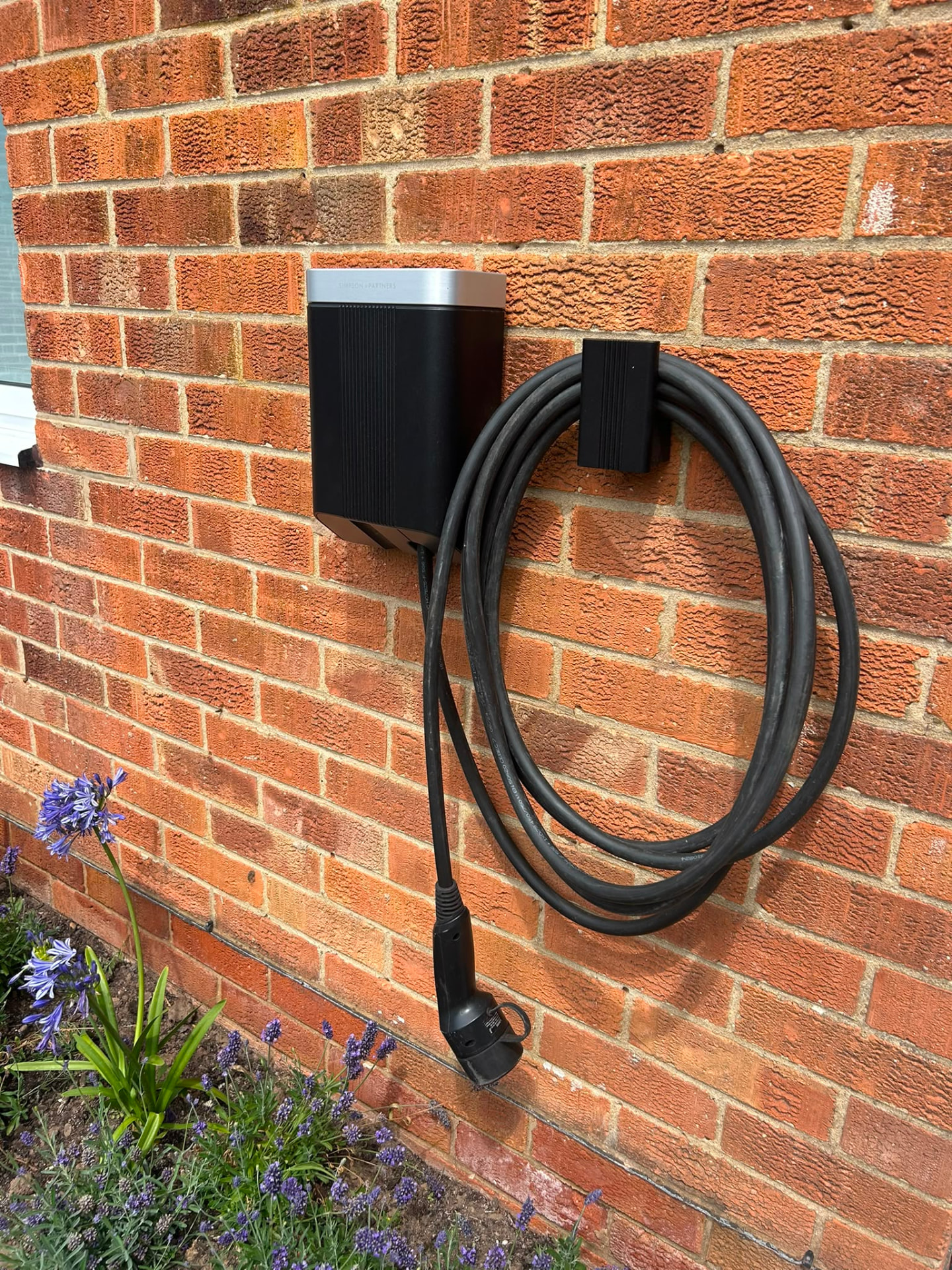
Derby · Home and workplace charge points
Home and workplace charge points on correctly sized circuits with load management, tariff-aware scheduling and integration into your automation and solar. More than a unit bolted to a wall.
NAPIT Full Scope registered · £10m public liability · 6-year NAPIT-backed workmanship guarantee on qualifying installations
16+ years
Domestic, commercial and industrial experience
Full Scope
NAPIT registered for all aspects of electrical work
6-year
NAPIT-backed workmanship guarantee on qualifying installs
£10m
Public and employers' liability cover
Free
Initial consultation, no obligation
The service
An EV charge point is a dedicated circuit with its own protection, a suitable earthing arrangement, and a unit that can manage its draw against the rest of the property's demand. Fitting the unit takes a few hours. Getting the supply confirmed and the circuit and protection right is what decides whether the installation is safe and reliable.
Load management is the part most often skipped. A 7kW charger is a big continuous load, and on a property with an electric shower, an oven and a heat pump the total can approach the incoming supply capacity. Load-managed installations monitor demand and cut charging current when the house draws heavily, so nothing trips and no supply upgrade is needed.
Because we install automation and solar too, chargers get set up to be genuinely useful. Scheduled into cheap overnight tariff windows, or driven by surplus generation, and visible in the same system as your heating and lighting.
What it costs to leave it
Charge points installed without a load assessment cause predictable trouble. The main breaker trips when the shower, the oven and the car all draw together, usually on a winter morning. Occupants respond by charging overnight only and treating the daytime as off-limits, a workaround for an installation nobody assessed properly in the first place.
Earthing is the safety-critical detail. Charge point installations need specific earthing arrangements, and getting it wrong on certain supply types creates a real shock risk during a fault. It's not visible and it won't show up in normal use, which is exactly why proper installation and certification exist.
The lesser cost is missed savings. A charger with no tariff scheduling charges whenever it's plugged in, often through the most expensive part of the day. One with no link to solar exports generation while buying electricity to charge the car at the same time. Both are configuration issues, and both are easily avoided.
How the job runs
01
We check the incoming supply, the consumer unit, the earthing arrangement, the parking position and the cable route, and confirm what the property can support.
02
Circuit design, protection, load management strategy, unit selection and mounting position, with a written quote and clear scope before work begins.
03
Dedicated circuit run and protected, earthing arrangement installed correctly for the supply type, unit mounted and cable route made tidy and weatherproof.
04
Full electrical testing, protective device verification, load management proved under real conditions, and certification issued and notified.
05
App set up, tariff scheduling configured, solar or automation integration enabled where present, and the whole thing demonstrated before we leave.
What you actually get
Load management measures total demand and modulates charging current, so the car charges alongside the shower and oven instead of competing with them.
Scheduling into overnight tariff windows means the vehicle charges when electricity is cheapest, automatically, with no timer to set each evening.
Where solar is installed, charging can follow surplus generation, so daytime output charges the vehicle instead of being exported at low value.
The earthing arrangement is designed for your supply type and proved during testing, which is the detail that separates a compliant installation from a risky one.
Cable routes planned and finished properly, with the unit positioned so the lead reaches the vehicle's port without stretching across a driveway.
Certification issued and notified through NAPIT, with a 6-year workmanship guarantee on qualifying installation work.
In detail
Charge point installations are governed by the supply behind them. Here's what we assess for homes and workplaces across Derby, Derbyshire and Nottinghamshire.
Every installation starts with what the supply can deliver and how the property is earthed. These checks determine the circuit design and, occasionally, whether a supply upgrade needs discussing with the network operator.
Load management lets a substantial charging load coexist with everything else on a domestic supply. Tariff scheduling is what makes it cheap.
Position determines whether the installation is pleasant to use day to day. Charging cables are short, heavy and awkward, and a unit in the wrong place is a daily irritation.
Workplace installations add access control, usage recording and the need to balance several charge points against one commercial supply.
Before you enquire
It depends on the unit chosen, the cable run length and whether the consumer unit has spare capacity. We don't publish prices, but the assessment is free and you get a written quote before work starts.
A straightforward domestic installation is usually done within a day. Long runs, board changes or workplace installations with multiple points take longer and are quoted with a duration.
Usually not. Load management lets a charger work within an existing supply by reducing charging current when household demand is high. We confirm this at the free assessment.
Yes, where solar is installed. Charging can follow surplus generation so daytime output goes into the vehicle instead of being exported at low value.
Tethered is more convenient day to day; untethered is tidier and more flexible across different vehicles. We'll talk through how you park and which suits you.
Charge points are designed for years of outdoor service. The connector and cable are the wearing parts on tethered units, and both are replaceable without changing the whole installation.
Yes. Workplace installations including multiple points, dynamic load balancing, user authentication and usage recording are all within scope.
Full electrical certification for the new circuit, notified through our NAPIT registration, along with test results for the installation.
Qualifying installation work carries a 6-year NAPIT-backed workmanship guarantee, with a minimum one-year guarantee on other work. The charge point carries its own manufacturer warranty.
Derby, Duffield, Belper, Ilkeston, Long Eaton, Ripley, Ashbourne, Matlock, Burton upon Trent, Nottingham, Chesterfield, Sheffield and the surrounding East Midlands.
Related services
Where we work
Derby · Nottingham · Duffield · Belper · Burton upon Trent · Sheffield · Ilkeston · Long Eaton and the wider East Midlands. See areas covered, read more about the company or return to the homepage.
Book a free assessment and we'll confirm what your supply supports, whether load management is needed, and how charging should be scheduled to cost you least.
NAPIT Full Scope · Official Loxone Partner · 6-year workmanship guarantee on qualifying installations · £10m public liability